

Since July 2, 2026, every Rust server starts by default on an internal processing mode called Jobs 3. Admins bothered by this switch could revert with a convar — a setting typed in the console or written into the server’s startup file — named UsePlayerUpdateJobs, simply set to 2. In the same post, Facepunch warned that this way out would close in August: the value 2 will still be accepted, but it will run mode 3 underneath. As of August 3, 2026, the studio has not yet published the date of its monthly update.
A way out that is closing
The “Common Ground” post, published on July 2, 2026, describes this transition in three stages. Facepunch says it let Jobs 3 mode run on its own servers for half the month and judged it stable, then promoted it to the default value so it could simplify the remaining code. The studio adds a sentence that directly concerns community servers: the way player state flows on the server side has been rewritten, and this rewrite forces server mods to update their own code.
The adaptation work therefore started on July 2, not in August. What the August update removes is the safety net. Until now, an admin whose extensions misbehaved could switch back to mode 2 while their plugin authors published a fix. After the August update, this setting will no longer do anything useful.
What “Jobs” means in a Rust server
A Rust server recalculates the state of the world several times per second: player positions, shots, network sends, anti-cheat checks. Historically, much of this work ran on a single thread, even when the machine had many cores. The “Jobs” system moves part of these tasks to other threads.
A thread (or thread of execution) is an independent computing queue. A multi-core processor can handle several at once, provided the software is written for it.
Facepunch details what level 3 brings: use of the UniTask library to avoid memory allocations tied to multi-threaded code, faster sending of player snapshots every frame, parallel execution of part of the network subscription updates, earlier scheduling of EAC and analytics tasks so the main thread stops waiting for them, and parallelization of the rest of the server-side anti-cheat logic.
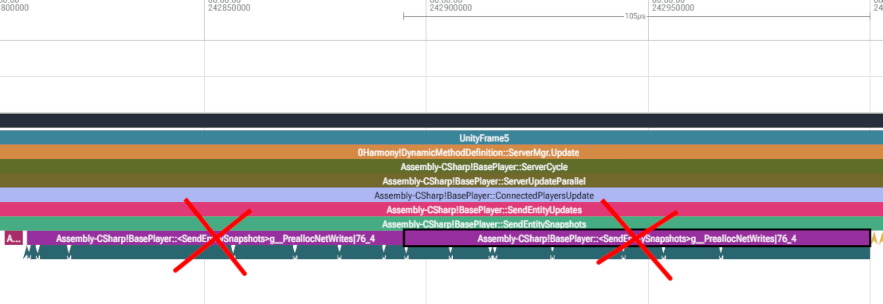
The studio also says it has started exploring a “Jobs 4” level, whose first contribution is parallelizing the collection of occlusion pairs on the server side. It warns that this level will probably take several months before it has enough substance to ship. No performance figures are published: the available data doesn’t say how much a server’s load drops, or from how many players the difference becomes noticeable.
July had already moved several markers
Two lines in the “Removed” section of the July changelog deserve an admin’s attention. The first removes all obsolete and generic versions of the BaseEntity.ClientRPC, ClientRPCEx, ClientRPCPlayer, ServerRPC and ServerRPCList calls; Facepunch invites developers to switch to the existing methods or write their own. An extension that still called these methods doesn’t just malfunction: it no longer finds the code it calls.
An RPC call (remote procedure call) lets the server trigger an action on connected clients, or the reverse. It’s the basic building block of many extensions.
The second removes support for full server demos. Classic client-side demo recording isn’t affected, and the studio even added, the same month, a compatibility layer that tries to run old demos on a recent version — with an explicit limit: it only works for demos recorded from that version onward, not for older archives.
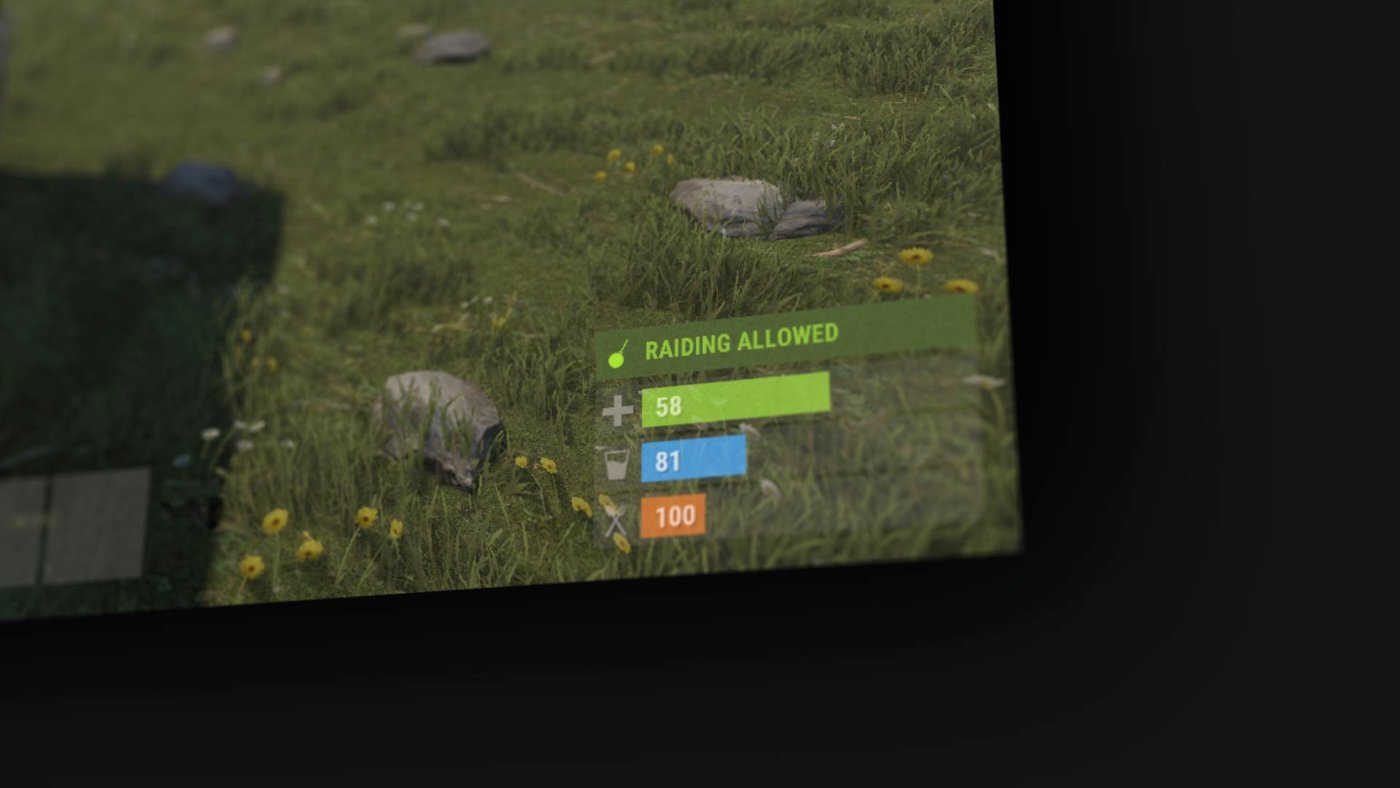
The same post also gives server owners new settings, this time in Softcore mode: raids are only allowed within a time window, set by default from 6 pm to 9 pm server local time, and Facepunch says it has shipped several convars to adjust it.
What Facepunch’s public log reveals about August’s content
Facepunch publishes its commits openly. It’s not an announcement, and nothing in it is final: a feature visible in a branch can be postponed, reworked or removed before release. With that caveat, as of August 3, 2026, the rust_reboot repository shows a branch named PlayerMaintainedMonuments, which sets the tone for the month.
It contains an item called heavy fuse, whose spawn rate was halved on August 2 and which was added to the underwater lab crates. A developer reworked the Power Plant on August 3 — removing recyclers from one room, repositioning others — and another relit a Launch Site building, stating explicitly that it was “for the control panel update”.
A second branch, satellite_crash, introduces two server settings named satellite.crate_fire_duration and satellite.wreck_fire_duration. Their values changed several times in two days, which points to ongoing balancing rather than a fixed state. A third series of commits adds stations to the underground rail network along with prefabs meant to make them appear more often during map generation: if shipped, this change will be visible from the first map generated after the wipe.
A final commit, dated August 3, stops sending vending machine and event markers — cargo, helicopter, travelling vendor — to the Rust+ companion app. As of that date, it’s the only one on the list to receive more downvotes than upvotes from the log’s readers, making it the most likely candidate for community discussion at release.
What you can prepare without waiting for the devblog
The update date isn’t official. The pace, however, is constant: the six monthly devblogs published since February 2026 all came out on a first Thursday — February 5, March 5, April 2, May 7, June 4 and July 2. The first Thursday of August 2026 falls on the 6th. It’s a deduction, not a confirmation, but it leaves little room for maneuver.
A wipe is a reset: buildings and inventories are erased and a new map is generated. Rust’s monthly updates come with one; the January 1st, 2026 post opened by noting that servers had just been wiped.
Three checks take little time. First, see whether UsePlayerUpdateJobs is still set to 2 in the startup configuration: if so, the line will become inoperative, and it’s better to observe actual behavior in mode 3 now rather than discover it on wipe day. Next, check with the authors of your installed extensions that they’ve integrated the July rewrite; an extension not updated since June is the first suspect if there’s a startup error. Finally, back up the configuration and data before the update window, since map reset and plugin updates fall on the same day. The backup method described for Palworld carries over without difficulty.
One point remains entirely beyond admins’ control: the final content. Until the August devblog is published, the list above describes work in progress, not an update. The only certainty lies in the sentence Facepunch wrote in black and white on July 2, and it concerns not a monument but a setting.
Further reading
- “Common Ground” devblog (July 2, 2026) — its UsePlayerJobs Changes section contains the announcement of Jobs 2 mode being removed in August.
- Official July 2026 changelist — the full list of additions, improvements and removals, including the removed RPC calls.
- rust_reboot repository commit log — continuously updated, it’s where content in preparation appears before any announcement.
- Updating a Satisfactory dedicated server — an example of a controlled update procedure, applicable to other games.
- What the Prosperity update changed for Space Engineers — another recent case of an update that hits server administration first.