

Pocketpair released three patches for Palworld between July 28 and 30, 2026, less than three weeks after version 1.0 came out. Several of these fixes directly target online play: until then, a dedicated Palworld server could disconnect all of its players during one specific boss fight. A second release targets game stability when mods are installed, and a third a loading screen stuck after the final battle. Nothing new is added: these three versions are strictly fixes.
Vocabulary. a patch is an update that doesn’t change the game’s content and only repairs malfunctions. Each patch has a version number, which lets you check precisely what’s running on a machine.
Three releases in three days
The sequence is tight. Version v1.0.2 came out on July 28, 2026 and makes up the bulk of the work: about twenty fixes spread across crashes, multiplayer, missions, achievements, display and controls. On July 29, a revision numbered v1.0.2.100993 was released with a single purpose, described by the studio as processing adjustments meant to improve game stability with mods. On July 30, a second revision, v1.0.2.101103, contains just one line: the fix for an infinite loading screen occurring, in some cases, after defeating the World Tree boss.
These last two revisions only apply to the PC version. In both cases, Pocketpair states that crossplay with other platforms isn’t affected, in other words a console player can keep joining a game hosted on PC.
The fight against Panthalus brought down online games
The fix with the biggest consequences for hosting is in the July 28 v1.0.2. Two entries are devoted to the same battle: the first fixes an issue where all players could be disconnected during the fight against Panthalus on a dedicated server, the second a player crash during that same fight, also on a dedicated server.
The studio’s wording matters. It wasn’t a single player losing their connection, but all participants. In a community game, this kind of incident means a general outage at the worst moment, in the middle of a boss fight, with the risk of losing the progress accumulated since the last autosave.
The same version fixes a third multiplayer-related defect: when a player was already in the World Tree area at the moment the host arrived there in turn, the terrain could fail to display correctly from the host’s point of view. On top of that comes an issue with the tower boss “Victor & Shadowbeak”, which could disappear after a teleport attack.
Sunreach and the World Tree, two areas under watch
The two regions added by version 1.0 account for a notable share of the fixes. Sunreach is a floating archipelago that appeared above the Palpagos archipelago; the World Tree is the area that closes the main story and hosts the final battle. They’re also the two busiest places in the game, and the most likely to put a machine under strain.
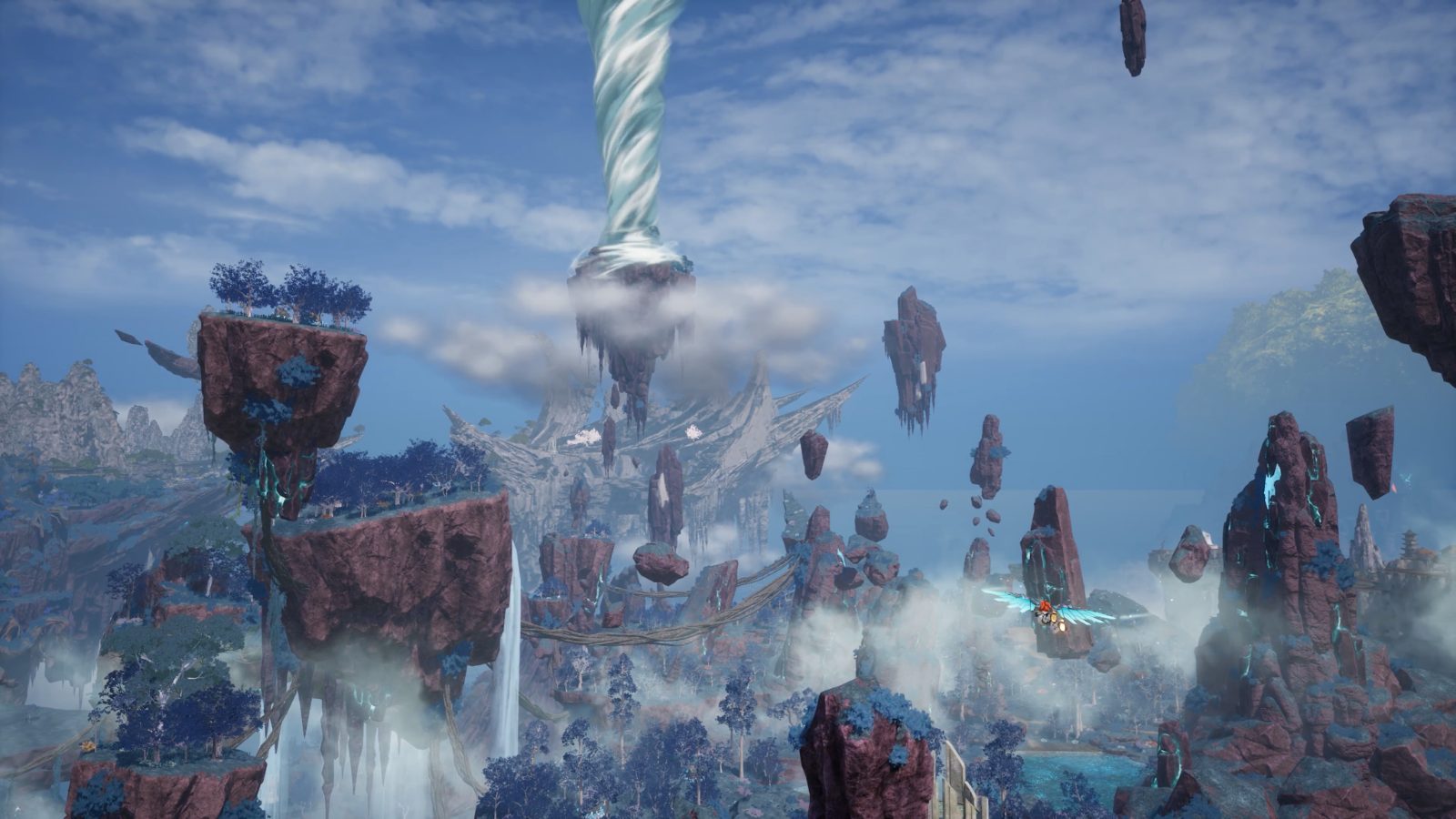
For Sunreach, v1.0.2 explicitly announces a reduction in processing load during play and improved performance. No figure accompanies this statement: the studio gives neither a frames-per-second gain nor a reduction in CPU usage. For the World Tree, the fixes are functional rather than quantitative — terrain display, loading stuck after the boss, the behavior of a player’s light while waiting to respawn when the host finishes the final fight without them.
Mods handled in a separate patch
The July 29 revision deserves to be singled out, as it’s unlike any other in the series. Its official title is “Mod Support Improvement” and its content fits in one sentence: processing adjustments were made to improve stability in games played with mods.
Key point. a mod is an unofficial modification added to the game by the community. On a dedicated server, mods usually have to be present on both the server and the player side, in compatible versions, or connection errors occur.
The studio doesn’t detail which malfunctions were targeted or which kinds of mods were involved. That’s a real limit of this release: for an admin, it says a problem existed without letting them know whether it affected their setup. The only solid conclusion is that a modded game that crashed before July 29 deserves another try after updating, before looking for the cause elsewhere.
What these patches mean for administration
The practical consequence is simple: a hosted game must run on the same version as the players joining it. As long as a server stays on a version earlier than July 30, 2026, the fixes described above don’t apply to it, even if the players themselves have received the update automatically. That’s what explains most connection error messages after an update.
Two habits limit bad surprises. The first is to back up the world before applying an update, even for a patch presented as minor: a recent backup remains the only way to go back if the server’s behavior changes. The second is to check the installed version after restarting, rather than assuming the update went through. Our tutorial on backing up a Palworld server details the steps.
On a Palworld plan in the Koinswift Panel, these two operations use the same tools: backups and version selection are available directly from the interface, with no command-line work. The dedicated page summarizes the capacity available by target number of players.
What these three versions don’t say
Pocketpair had published nothing since July 30, 2026 at the time of writing. The studio hasn’t given a timeline for what comes next, nor announced whether other patches are in preparation. No separate notes have been published for the dedicated server application either, whose changes follow the game’s without separate communication.
As a matter of analysis, a pattern emerges that can’t be confirmed: the heaviest fixes all concern endgame battles played with several people — Panthalus, Victor & Shadowbeak, the World Tree boss. This could indicate that these sequences, the densest in effects and simultaneous entities, have been the weak spot of online play since the move to 1.0. The published data doesn’t yet confirm it, and we’ll probably have to wait for the next releases to know whether the studio continues in this direction.
Further reading
- Official Palworld announcements — the reference source for release notes, published by Pocketpair as patches come out.
- Palworld dedicated server build history — lets you check the exact date of the latest server build released.
- Our article on the changes brought by Palworld 1.0 — the full background of the version these patches depend on.
- Backing up a Palworld server before an update — the procedure to follow before every version change.
- Palworld hosting plans — the capacity available depending on the size of the player group.