

The list of new features in Minecraft 26.3 is closed. On August 4, 2026, Mojang released the seventh snapshot of this upcoming version, presenting it as the one that brings “the last features” of its third batch of the year. For players, the harvest fits in two lines: concrete stairs and slabs in all sixteen colors, and maps hidden at the bottom of abandoned camp chests. For Java server admins, the essentials lie elsewhere. Several internal conventions change at once, and some existing data packs will no longer work as they are.
Snapshot: a test version published by Mojang before the stable release. It’s for trying new features and reporting bugs, never for running a server open to the public.
Two visible new features, and only one truly new
The first addition is purely decorative: concrete, which until now only existed as full blocks, now comes as stairs and slabs in all sixteen of the game’s colors. The recipe stays the same as classic concrete — a dye, sand and gravel to get powder, water to solidify it — then a trip to the crafting table for shaping.
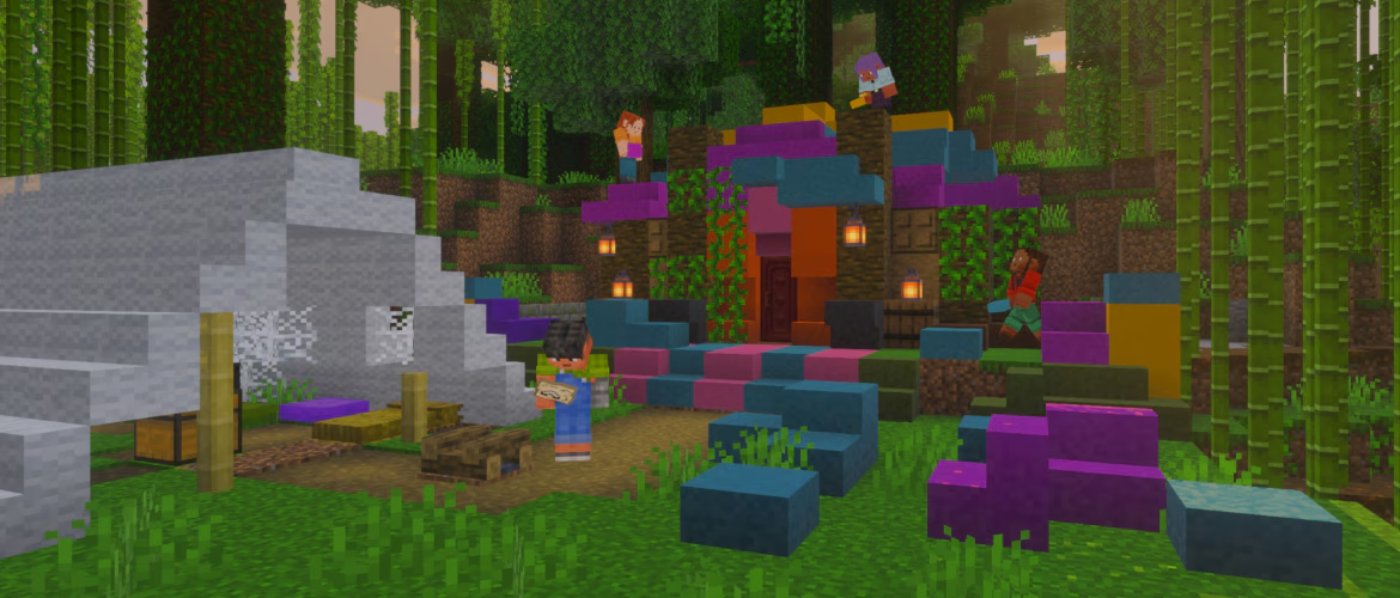
The second is more structural. Abandoned camps, a structure introduced earlier in the 26.3 cycle that can appear in any biome, can now contain maps in their chests. These maps lead either to other camps — in the bamboo jungle, cherry grove, birch forest, sparse forest, flower forest, pale garden, swamp and windswept forest — or to already known structures: ancient city, trial chambers, mineshaft, desert pyramid, jungle temple, warm ocean ruins and woodland mansion. Camp loot was tweaked along the way: the firework rocket gives way to gunpowder in the chests.
Mojang says these two additions will arrive “very soon” in Minecraft Bedrock’s test versions, without giving a date.
Explorer maps change nature
This is the most discreet change and the one with the heaviest consequences. Until now, a treasure map or a woodland mansion map was just an ordinary filled map, renamed and given extra data. The August 4 snapshot makes them items in their own right: ocean explorer map, woodland explorer map, trial explorer map, jungle explorer map, swamp explorer map, desert, plains, savanna, snowy and taiga village maps, buried treasure map, ancient city map, mineshaft map, desert pyramid map, abandoned camp map and warm ocean ruins map. Each has its own icon.
Maps already present in a world are converted to the matching new item when the save loads. They can still be duplicated at the crafting table, and the copy keeps the same item type. However, these maps can no longer be zoomed out, either at the crafting table or the cartography table: only those with the extendable_maps tag keep this ability. Treasure maps, which could be enlarged in both places, therefore lose this flexibility.
For a server, the question to ask is simple: does anything on this instance hand out or check maps based on the “filled map” item? A shop, a starter kit, a custom villager trade or a quest written as a data pack could all be affected.
What breaks in data packs
Data pack: a folder of files you drop into a world to change the game’s rules — loot, recipes, structures, terrain generation — without touching the server code. Unlike a plugin, it’s read directly by the game.
The data pack version moves to 115.0, the resource pack version to 95.0. Three breaking changes deserve a careful read.
First, the description of a block state is renamed: the Name field becomes id, and Properties becomes properties. A block’s default state can also be referred to directly by its identifier, in a shorter form.
Next, the loot function that produced explorer maps no longer changes the type of the item it applies to: it just adds the map data to it. A pack that previously supplied a blank map must now supply a filled map or one of the new items directly. And if no matching structure is found, the item stays without a map ID: Mojang recommends removing it explicitly, as the base game’s loot tables and villager trades now do.
Finally, the component that defined an item’s swing animation disappears in favor of two separate components, one for attacking and one for interacting. Existing items are migrated to the default animation. The swing command also gains two optional arguments: the animation type and its duration.
On top of this comes a change Mojang thought worth commenting on itself: the density functions and noises used to generate terrain are no longer computed in double precision but in single precision, at every intermediate step. The studio acknowledges that some packs relied on the rounding of these calculations, says it has planned alternatives for the known cases, and explicitly asks for feedback on the others. Servers using custom terrain generation are the first concerned — the noise format had already changed in the previous snapshot.
A useful detail for diagnosis: a world’s level.dat file now keeps a history of the data versions it has gone through.
What Mojang didn’t say
No release date has been given for stable version 26.3. On the contrary, the studio points out that these features are “still in development” and that their description may still change. Version 26.2, released on June 16, 2026, remains the latest stable version of Minecraft Java to date.
One point deserves to be read for what it is and nothing more: the snapshot adds support, for Realms, for additional server regions in Canada, Mexico, South Africa and Arizona, “should they become available in the future”. It’s technical groundwork, not an announced launch, and it only concerns Mojang’s hosting service, not self-hosted servers.
At this stage, the fact that the studio itself announces the last batch of features in testing suggests the cycle is entering its stabilization phase. The available data doesn’t yet confirm a timeline, and nothing prevents Mojang from adding or removing an element before the final version.
What a 26.2 server can do right now
Nothing forces you to move. A server open to the public has no reason to run on a snapshot: these versions can corrupt a world, and Mojang points this out with every release. The right window for action is the one opening now, before the stable release.
Three checks are enough to cover the essentials. List the active data packs and spot those that handle block states, maps or terrain generation. Duplicate the world and load the copy on the snapshot, in a separate folder, to see how the existing maps convert. And back up before any operation, since items are converted when the world loads.
The Koinswift Panel covers these three steps without the command line: version selection to switch a test instance, the file manager to add or remove a data pack, and backups to roll back if the test copy goes wrong. Support is reachable 7 days a week, and everything runs on a secure, filtered network infrastructure.
Further reading
Full notes for snapshot 26.3-snapshot-7 (Minecraft.net) — the exhaustive list of technical changes, tags and fixed bugs, published by the Java team on August 4, 2026.
Mojang’s presentation of the feature batch — the editorial article summarizing the drop’s features, including those already released in testing.
What the previous snapshot changed — an overview of the multiplayer and world generation changes published in late July 2026.
Migrating a Minecraft server to Paper — useful if you’re considering switching server software before the stable version rather than after.
Mojang’s bug tracker — the place to report abnormal behavior encountered during your tests, and to check whether the problem is already known.